
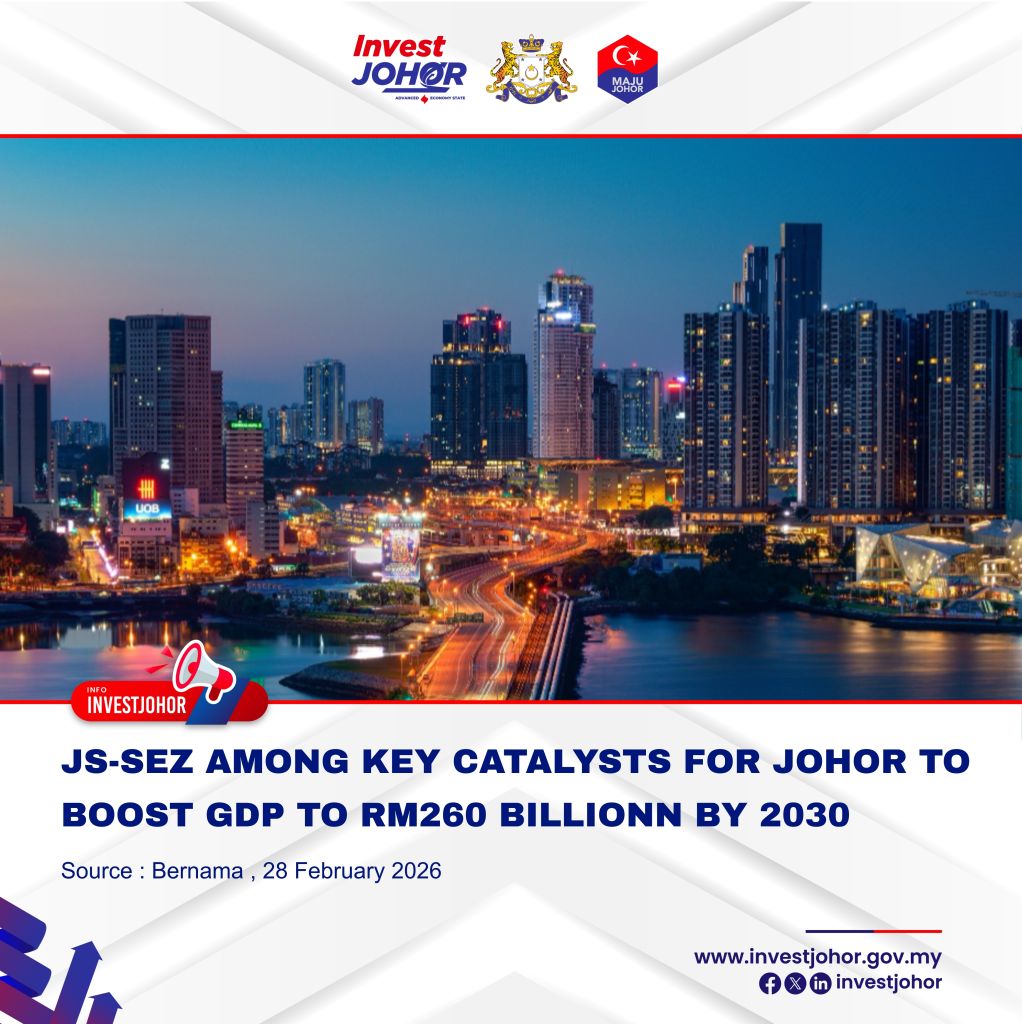
Johor’s target of achieving a gross domestic product (GDP) of RM260 billion by 2030 has been described as realistic, with the Johor–Singapore Special Economic Zone (JS-SEZ) expected to be one of the main drivers of the state’s economic growth.
Associate Prof Dr Mohd Effandi Yusoff, senior lecturer at Universiti Teknologi Malaysia’s Faculty of Management, said the target is achievable provided several critical economic factors are effectively implemented and managed over the next five years.
“Johor is in a solid position to attract domestic and foreign investments. A peaceful and stable environment is also an important factor in building investor confidence and ensuring that development can be carried out sustainably and continuously,” he told Bernama when contacted.
Johor has already shown encouraging performance, recording the country’s highest approved investments of RM91.1 billion in the first nine months of 2025, surpassing Selangor (RM51.9 billion), Kuala Lumpur (RM45.9 billion) and Penang (RM23.7 billion).
Mohd Effandi said most importance factors requiring attention is the ability to integrate economic between Johor and Singapore, citing the development model of Shenzhen and Hong Kong as example.
In the context of the JS-SEZ, he said, research and development (R&D), financial activities could be focused in Singapore, while Johor concentrates on high-value manufacturing, logistics and supply chains aspects.
“This model enables both regions to leverage their respective competitive advantages ,If the integration is implemented strategically, Johor will directly benefit from the economic outcome, “he said.
According to him, talent availability will be a key catalyst in supporting the transition to an innovation- and high technology-based economy.
“Johor has several public and private higher education institutions capable of producing skilled manpower. In fact, universities outside Johor are also able to supply skilled and semi-skilled workers in line with rising industry needs,” he said.
In terms of infrastructure, he noted that projects involving efficient transportation and cross-border facilities will accelerate the flow of capital, goods and labour.
Mohd Effandi said the Rapid Transit System Link (RTS Link) between Johor Bahru and Singapore, digital customs clearance and the development of other supporting infrastructure will serve as key catalysts for attracting high-quality investments into the state.
The JS-SEZ Master Plan and Investment Blueprint will be launched on March 30.
Established through an agreement signed on Jan 7 last year, the JS-SEZ is expected to create more than 20,000 high-skilled job opportunities.
