

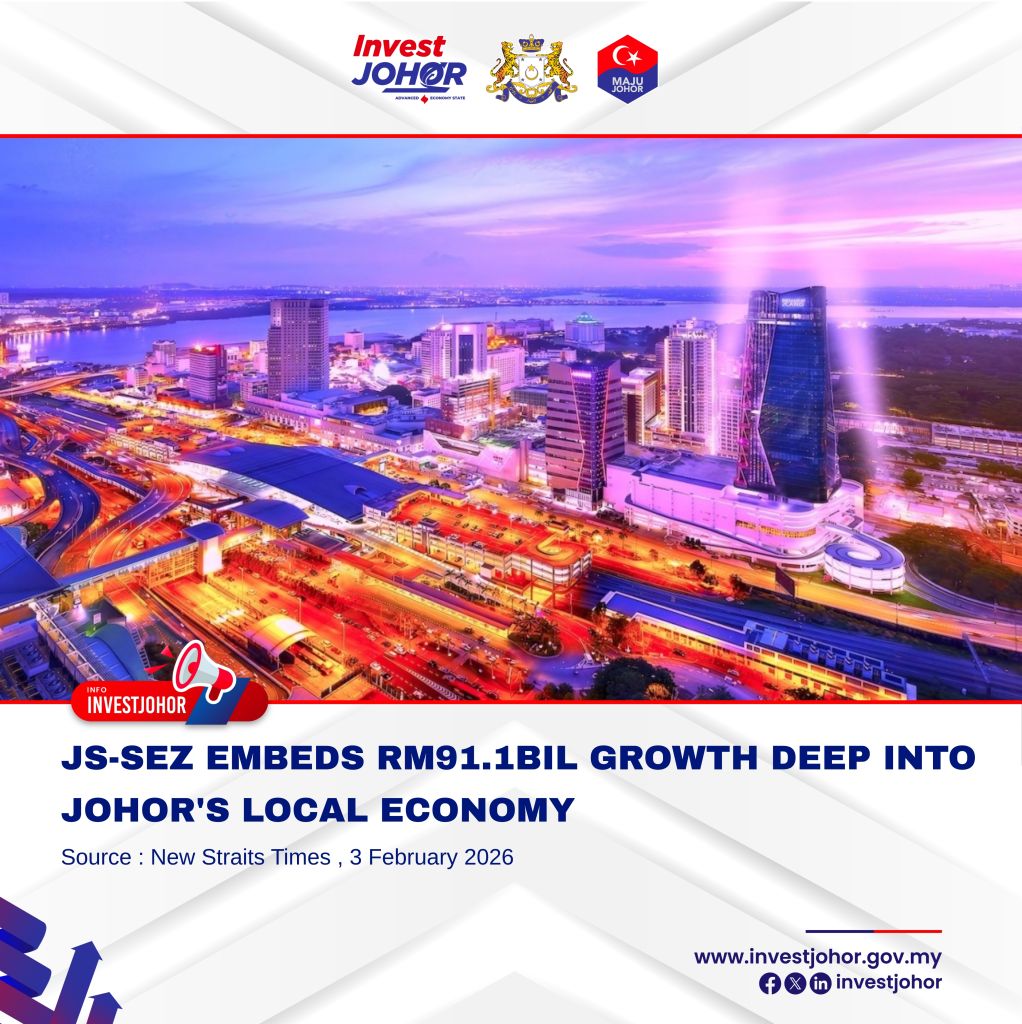
The Johor–Singapore Special Economic Zone is entering its second phase, channeling investments to create jobs, boost local
businesses, and drive sustainable economic growth across the state.
By the third quarter of 2025 (Q3 FY25), Johor had registered a record RM91.1 billion in approved investment.
Johor Investment, Trade, Consumer Affairs and Human Resources Committee chairman Lee Ting Han said the milestone reflects growing investor confidence in Johor’s policy certainty, execution speed and cross-border economic positioning with Singapore.
“JS-SEZ was never designed as a short-term sprint or a project for big corporations alone. It is a long-term development plan meant to be inclusive that brings benefits to local businesses, communities and future generations,” he said.
Johor has surged to the forefront of Malaysia’s economy as record investments under the JS-SEZ fuel a new wave of data centres, artificial intelligence projects and high-value jobs.
The state’s economy expanded by 6.4 per cent in 2024, the highest growth rate in Malaysia, outperforming the national average of 5.1 per cent.
Growth last year was projected to be between 6.0 per cent and 6.5 per cent, while 2026 is expected to accelerate further to between 7.3 per cent and 7.8 per cent, significantly above national forecasts.
At the core of JS-SEZ’s momentum is the rapid rise of Johor as a regional digital infrastructure hub.
Lee said Johor’s data centre capacity expanded from just 1 megawatt in 2022 to nearly 2,000 megawatts in 2025, with total approved projects reaching 5,500 megawatts.
“This is not just about building more data centres. We want to turn computing power into AI dividends, talent development and a complete digital ecosystem, from energy management and green buildings to cybersecurity, cloud services and automation,” he told the Business Times.
Lee stressed that JS-SEZ’s success will ultimately be measured by how deeply it penetrates the local economy.
The state has set a minimum 30 per cent local participation benchmark, while service sectors such as logistics, finance, engineering, maintenance and professional services are already being dominated by Johor-based firms.
Over the first five years, JS-SEZ is expected to generate 20,000 high-quality, skilled jobs, particularly in advanced manufacturing, the digital economy and clean energy.
Looking ahead, Lee said the state’s strategy is aligned with the 13th Malaysia Plan, shifting the economy from “Made in Malaysia” to “Made by Malaysia” by strengthening economic complexity, technology content and institutional capacity.
“In a volatile global environment marked by geopolitical tensions and supply chain realignment, investors are prioritising stability and predictability.
“JS-SEZ was created to answer this need… not to chase trends, but to build structural competitiveness,” he said.
Lee added that improved cross-border mobility, including the RTS Link that is expected to be operational in 2027, digitalised immigration processes and regulatory sandboxes, will further enhance productivity and talent flows between Johor and Singapore.
“JS-SEZ is an open invitation to local enterprises, regional partners and global players to build a resilient economic platform together.
“The goal is not just growth, but sustainable prosperity that lasts beyond political and economic cycles,” he said.
