
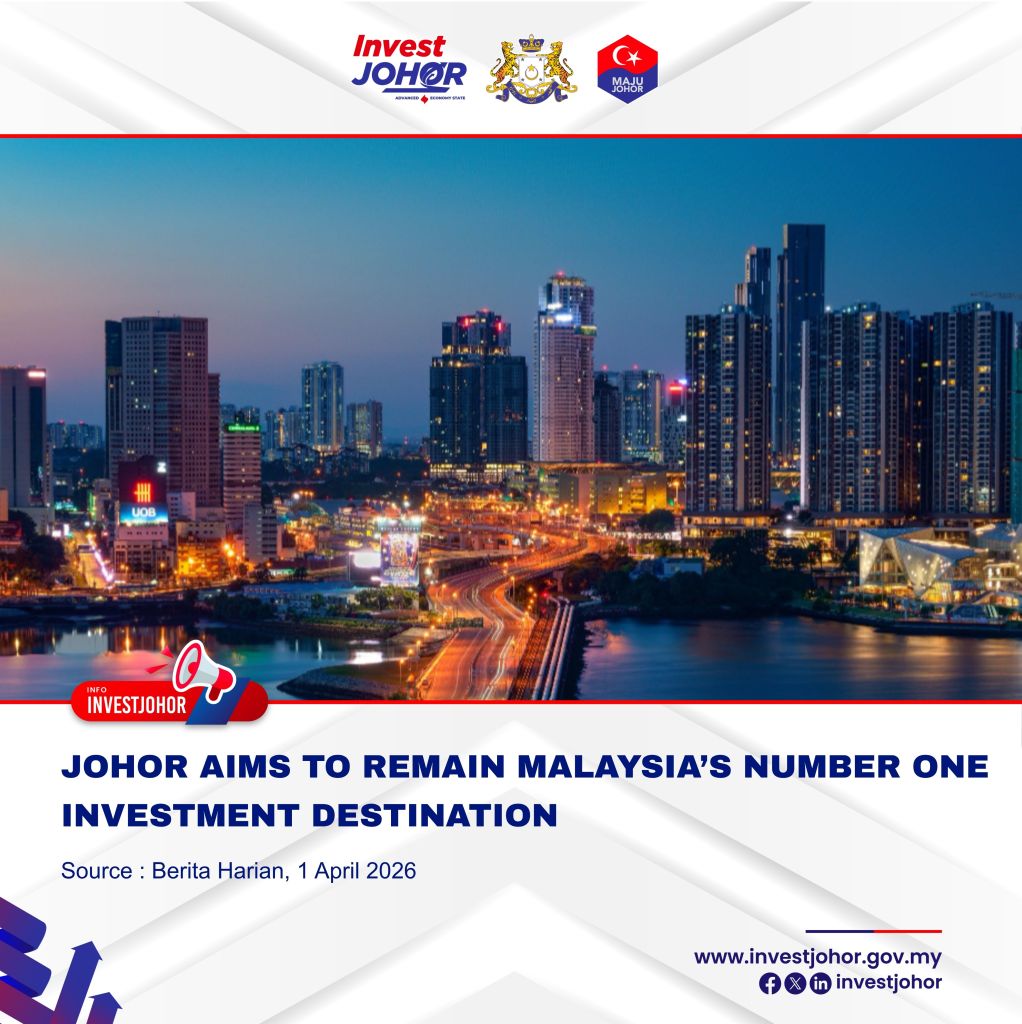
Johor is committed to maintaining its position as the country’s leading investment destination and staying at the forefront of foreign direct investment (FDI) inflows, which recorded RM110.1 billion in 2025, the highest among all states in Malaysia.
Johor’s Economic and Investment Advisor, Hasni Mohammad, said the state will not become complacent despite its strong performance. Instead, it will continue enhancing its competitiveness and strengthening its investment ecosystem.
He said the Johor-Singapore Special Economic Zone (JS-SEZ) serves as a key strategic roadmap to provide clarity and certainty to both new and existing investors, while enabling the state to sustain and expand current investments.
“What is important now is for Johor to maintain its momentum and continue being the preferred destination for investors.
“We are not only focusing on attracting new investments but also strengthening and expanding existing ones. The JS-SEZ will address uncertainties and provide a clear framework for investors,” he said during his speech at the Asia Summit on Advanced Innovation & Manufacturing 2026 today.
Efforts to enhance cross-border connectivity between Johor and Singapore are also being accelerated under the JS-SEZ, including immigration clearance using QR codes, a digital cargo system, and the Rapid Transit System (RTS) Link which is expected to begin operations.
Hasni said the RTS Link, scheduled to commence operations in January 2027, is expected to carry up to 10,000 passengers per hour in each direction, potentially transforming travel patterns across one of the busiest land border crossings in the world.
Currently, the route records about 300,000 daily movements, including 100,000 motorcyclists.
“We cannot afford any disruption in the system, whether it involves QR code clearance, digital cargo, or the RTS itself.
“All these initiatives must operate smoothly to support the increasing cross-border movement,” he said.
Hasni, who is also the Executive Chairman of the Johor-Singapore Special Economic Zone Office (JETCO), said improvements in connectivity could significantly change commuting trends, with two-way travel between Johor and Singapore expected to increase due to more efficient travel systems.
From an industrial perspective, he noted that Johor currently hosts the largest number of data centres in Southeast Asia, contributing more than 50% of the state’s total FDI last year.
However, he acknowledged that the sector’s high demand for electricity and water poses sustainability challenges, particularly in the context of climate change and resource constraints.
“We need to move away from dependence on coal-based energy towards renewable energy to ensure Johor remains attractive to investors while safeguarding long-term sustainability,” he said.
He added that the state government has established the Johor Sustainability Centre to drive green initiatives and technology adoption to support the transition, while encouraging industries to improve energy efficiency.
A total of 126 companies have been identified as managing energy inefficiently, and the government is offering incentives and tax exemptions to encourage a transition toward renewable energy usage. – BERNAMA
