
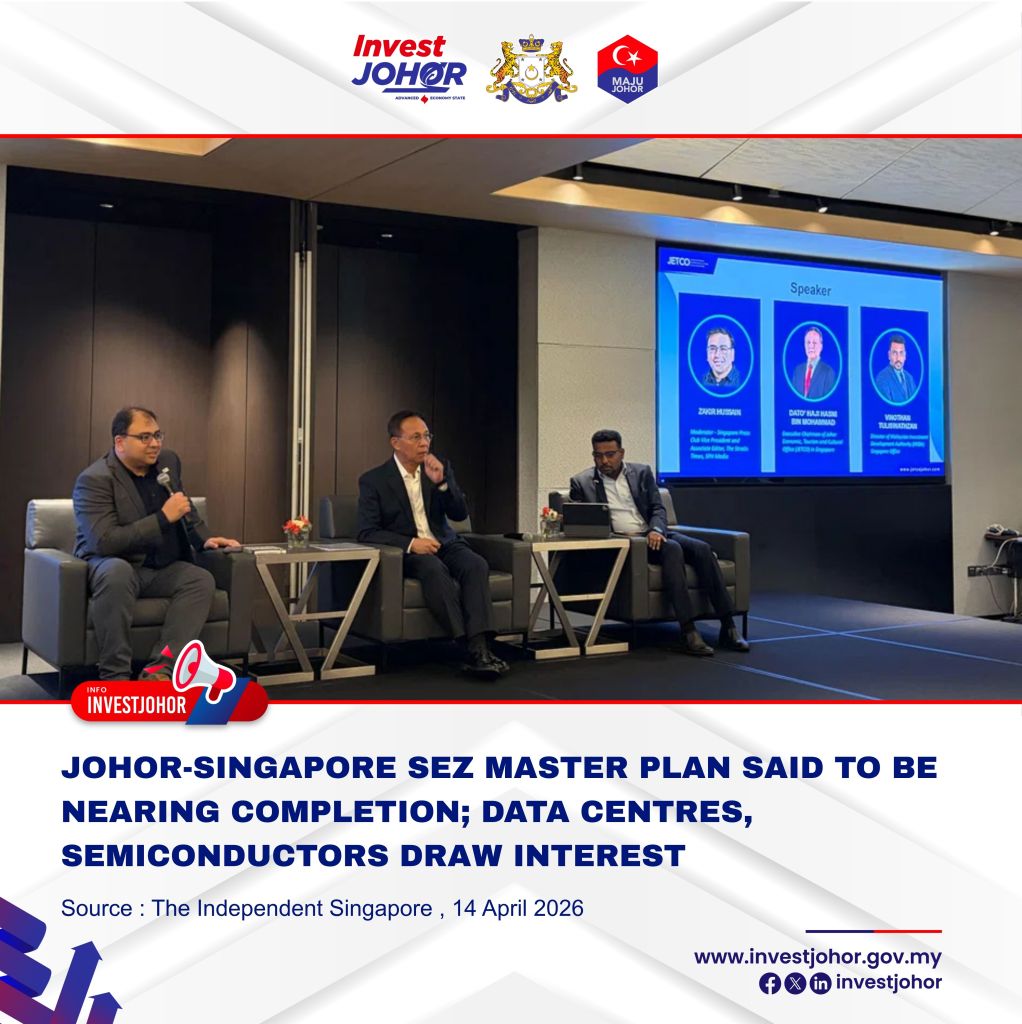
The Johor-Singapore Special Economic Zone (JS-SEZ) is expected to unveil its strategic master plan in the coming months, with data centres and semiconductors among the sectors drawing interest from investors.
Panellists at a dialogue jointly organised by the Singapore Press Club and Johor Economic, Tourism and Cultural Office (Jetco) Singapore on Monday (Apr 13) highlighted how the zone could be shaped as a complementary ecosystem, pairing Singapore’s strengths as a global business hub with Johor’s land and resource advantages.
“We are not talking about a zero-sum game here,” said Vinothan Tulisi, director of Malaysian Investment Development Authority’s Singapore office.
The JS-SEZ, a bilateral initiative signed in January 2025, aims to create a seamless economic corridor between Singapore and Malaysia. The zone targets accelerated growth across 11 key sectors, aiming to attract international investment and improve cross-border flow of goods and people.
The master plan was supposed to be launched in March, but it was delayed.
𝗖𝗼𝗻𝗻𝗲𝗰𝘁𝗶𝘃𝗶𝘁𝘆 𝗶𝘀 𝗸𝗲𝘆
A critical enabler of the JS-SEZ will be the Johor Bahru-Singapore Rapid Transit System (RTS). It is expected to be completed by the end of this year and be operational by the start of next year.
“The (upcoming) Johor Bahru-Singapore RTS will take about 10,000 passengers an hour on both sides,” said panellist Haji Hasni Mohammad, executive chairman of Jetco in Singapore. He added that it is important for the RTS to run smoothly in order to boost investor confidence in the JS-SEZ.
Tulisi noted that both Singapore and Malaysia have introduced QR clearance, which is passport free. It has “significantly reduced traffic because of clearance, and is something that would also be extended to the RTS”.
𝗗𝗮𝘁𝗮 𝗰𝗲𝗻𝘁𝗿𝗲𝘀, 𝘀𝗲𝗺𝗶𝗰𝗼𝗻𝗱𝘂𝗰𝘁𝗼𝗿𝘀 𝗱𝗿𝗮𝘄𝗶𝗻𝗴 𝗶𝗻𝘃𝗲𝘀𝘁𝗼𝗿 𝗶𝗻𝘁𝗲𝗿𝗲𝘀𝘁
Panellists pointed to growing interest in sectors aligned with the zone’s cost and infrastructure advantages, particularly within the digital economy.
“The digital economy has two sides, which is the digital technology provider and the digital infrastructure providers,” said Tulisi. And out of the two, “more traction is in the digital infrastructure, which is the data centres”.
The semiconductor sector is also gaining ground. Tulisi highlighted that there is “a good fraction of Singaporean-based companies that are involved in the supply chain, and they believe that it makes more sense to set up a shop in Johor, to serve their Singapore clients competitively in terms of the cost”.
F&B is another area seeing activity. Tulisi cited an example of a Korean-owned company setting up its central kitchen in Johor, while having its regional headquarters in Singapore.
The central kitchen – which is halal-certified – allows the company to “have a competitive edge to export their products in the region, even in the Middle East”, Tulisi added.
One focus area is the petrochemicals sector, which is seeing a shift towards being more green. There is growing interest in hydrogenated vegetable oils, for example. Tulisi emphasised that Johor has the resources, and it has “40 to 50 oil palm mills” as a ready base for sustainable energy production.
𝗔 𝗺𝗼𝗱𝗲𝗹 𝗯𝘂𝗶𝗹𝘁 𝗼𝗻 𝗺𝘂𝘁𝘂𝗮𝗹 𝗴𝗮𝗶𝗻𝘀
Panellists drew parallels between the JS-SEZ and the Hong Kong-Shenzhen model, describing how a “twinning approach” could support cross-border integration.
“Singapore is the financial hub and headquarters for international multinational companies, where Johor next door has space (and) labour at a lower cost compared to Singapore,” said Hasni.
Tulisi added that a “twinning model” would work best, reinforcing the positioning of Malaysia and Singapore as a joint regional investment destination.
This panel was moderated by Zakir Hussain, vice-president of Singapore Press Club and associate editor at The Straits Times.

[…] MALAYSIA – Media OutReach Newswire – 16 June 2026 – As the Johor-Singapore Special Economic Zone (JS-SEZ) prepares to unveil its strategic master plan this yea… Forest City Special Financial Zone (SFZ), a growing residential and commercial hub designated as a […]