
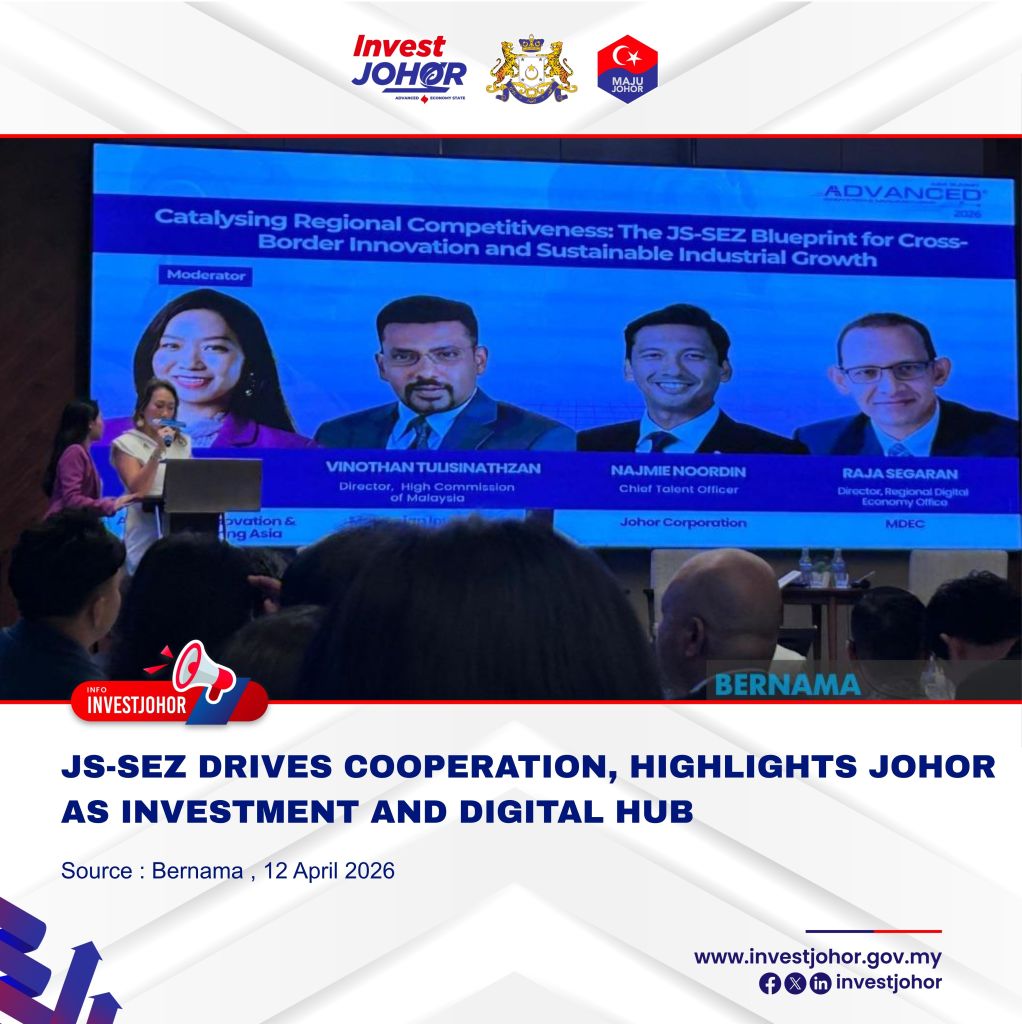
Strong cooperation among various stakeholders, rooted in a holistic ecosystem approach, is expected to accelerate Johor’s economic transformation, particularly through the Johor-Singapore Special Economic Zone (JS-SEZ).
Malaysian Investment Development Authority (MIDA) Director in Singapore, T. Vinothan, stated that coordination between the government, industry players, and investors is critical to ensuring the smooth implementation of initiatives covering investment, talent, and digital transformation.
He noted that the Johor–Singapore Joint Ministerial Committee (JSCMC) has been established to monitor progress and implementation outcomes under the JS-SEZ, supported by specialized working groups focusing on digitalization, talent development, and the ease of doing business.
“The primary role of these working groups is to ensure we keep moving forward. It also aims to discuss key matters regarding how relevant the JS-SEZ will remain over the next five to ten years.
“The agreement signed with Singapore is not just a memorandum of understanding (MOU), but a functional agreement. I believe good coordination within our own ecosystem is vital to ensure this is not merely a policy document, but an initiative capable of producing real results with growth extending across Malaysia,” he said.
He spoke during a session titled ‘Catalysing Regional Competitiveness: The JS-SEZ Blueprint for Cross-Border Innovation and Sustainable Industrial Growth’ in conjunction with the Asia Summit Advanced Innovation & Manufacturing 2026 event here today.
Other panelists included Johor Corporation Chief Talent Officer Najmie Noordin and Malaysia Digital Economy Corporation (MDEC) Regional Digital Economy Office Director Raja Segaran.
In a related development, he mentioned that ongoing initiatives such as the passport-free QR code clearance system, streamlined customs processes, and the Rapid Transit System (RTS) Link—expected to be operational by January 2027—will significantly enhance the cross-border movement of people and goods.
Vinothan also highlighted the role of the Invest Malaysia Facilitation Centre in Johor (IMFC-J), a one-stop center bringing together key decision-makers from various ministries and agencies to further streamline investment efforts.
“For the period of January to December 2025, IMFC-J handled more than 1,000 inquiries with approximately 131 potential projects evaluated, reflecting strong investor interest. The goal is to ensure a smooth investment journey,” he said.
Meanwhile, Najmie stated that Johor offers a strong value proposition, supported by talent availability, proactive leadership, and alignment between the Federal and state governments.
Johor produces approximately 35,000 to 36,000 graduates annually, largely in Science, Technology, Engineering, and Mathematics (STEM) fields, including technical and engineering disciplines.
Institutions such as Universiti Teknologi Malaysia (UTM) and Universiti Tun Hussein Onn Malaysia (UTHM) continue to play a vital role in supplying skilled labor, supported by initiatives under the Johor Talent Development Council (JTDC).
“Programs like ‘Skills for Johor,’ with an allocation of about RM20 million this year, focus on upskilling and reskilling the workforce to meet industry needs with the support of training providers, including Johor Skills and polytechnics,” he said.
At the same time, Johor’s economic diversity and rapidly growing talent pool provide opportunities for investors to develop and expand their businesses over time.
The state, he added, aims to double its Gross Domestic Product (GDP) from RM150 billion to RM260 billion by 2030.
Another panelist, Raja Segaran, highlighted MDEC’s role in strengthening cooperation with the private sector, especially in fast-growing fields like Artificial Intelligence (AI).
According to him, collaboration opportunities span the entire AI value chain, including infrastructure, graphics processing units (GPU), GPU-as-a-service (GPUaaS), data, foundation models, and AI applications, with MDEC also supporting companies as preferred market partners.
“MDEC works closely with IMFC-J, MIDA, and the Iskandar Regional Development Authority (IRDA) to ensure investment efforts are coordinated alongside value creation for investors, including those from Singapore,” he said.
